I grew up in Oregon.
I’m used to rain. I’m used to wind. I’m used to winter storms and the occasional power outage.
Honestly, by mid-to-late October, we’ve usually had at least one good windstorm roll through. It’s just part of living in Oregon.
And with more stormy weather moving through the state this week, I’ve been thinking a lot about how we prepare for the fall and winter months.
Because as someone who has lived in Oregon my entire life, I thought I knew what to expect when it came to bad weather.
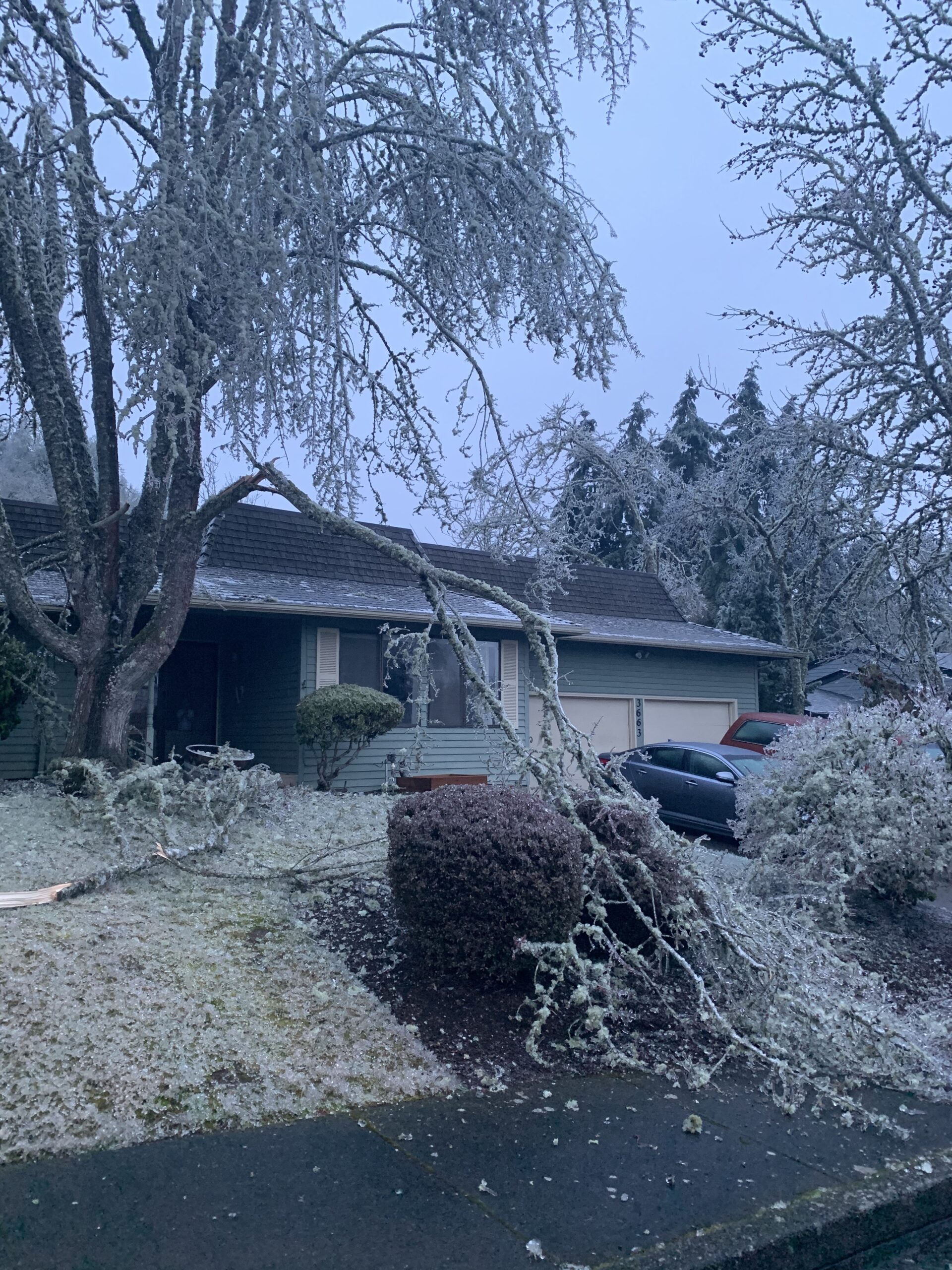
But nothing prepared me for the Oregon ice storm of 2021.
It was, without question, the worst storm I’ve ever experienced here.
And we were completely unprepared for it.
The ice was incredibly thick—around two inches in places near us and even thicker in some areas.
But what I remember most isn’t seeing the ice.
It’s hearing the trees.
The Night I Will Never Forget
We live in a neighborhood with substantial mature trees, including several very close to our house.
That night, my husband and I lay in bed listening to branches and trees SNAP throughout our neighborhood.
Over.
And over.
And over.
Then you’d hear them fall.
Sometimes we’d feel the house shake.
There was absolutely nothing we could do about it.
There was a tree close enough to our son’s bedroom that we brought him into our room to sleep with us. Although I’m not sure any of us actually slept.
I remember lying there basically praying none of the trees came down on our house.
We did have substantial tree limbs hit our roof that night, but thankfully none caused serious damage.
By morning, our neighborhood looked completely different.
Trees and branches were everywhere. Roads into and out of our neighborhood were blocked.
And we had no power.
We Lost Power for Eight Days
At first, we assumed the electricity would come back relatively quickly.
That’s what normally happened.
A storm comes through Oregon. The power goes out. Maybe it’s out for a few hours or even a day.
You deal with it.
Except this time it didn’t come back.
We were without power for eight full days.
Some people in our neighborhood were without it for around two weeks.
We had prepared for maybe a day without electricity.
We were absolutely not prepared for eight.
We didn’t have a generator. We didn’t have enough flashlights or batteries. We didn’t have a real emergency plan.
We had a child, pets and a diabetic dog whose insulin needed appropriate temperature-controlled storage.
And because trees were blocking roads around our neighborhood, we couldn’t simply hop in the car and go buy everything we suddenly realized we needed.
Thankfully, we have two gas fireplaces, which helped keep parts of the house warm.
After about two days, my mom’s power was restored, so we sent our son to stay with her while my husband and I stayed home and roughed it out.
That storm made one thing very clear:
We needed a better plan.
The $600 Generator I Said We Didn’t Need
Before the ice storm, my husband had suggested buying a gas generator.
It was going to cost around $600.
And I thought it was ridiculous.
Why would we spend $600 on a generator we’d probably never use?
If we lost power, it would be restored in a day or two like it always was.
Right?
Then the ice storm happened.
Ironically, I had gone to Costco the day before and spent around $400 on groceries, thinking it would be smart to stock up before the storm.
You can probably guess how that worked out.
We eventually had to throw away that big grocery haul along with other refrigerated and frozen food we already had.
Suddenly, that $600 generator didn’t seem so expensive.


As soon as we recovered from the storm, a generator went straight to the top of our list.
Of course, everyone else apparently had the same realization, and it took about a month before we could actually find one in stock.
But we have one now.
And after what we experienced?
For our family, a generator is non-negotiable.
I hope we never experience another eight-day power outage.
But I’m also never going to assume we won’t.
What We Keep for Oregon Winter Storms Now
I’m not trying to build a bunker, and I’m definitely not preparing for the apocalypse.
I simply never want to wake up after another major storm and realize we have no lights, no way to keep important things powered and absolutely no plan.
These are the things our family keeps around now after learning the hard way.
1. A Generator
Yes, the generator I said we didn’t need.
It’s now number one on my list.
For us, it means being able to keep essentials like our refrigerator and freezer powered during a longer outage.
After throwing away hundreds of dollars in food once, I have no desire to do it again.
One important note: portable fuel-burning generators can cause deadly carbon monoxide poisoning and need to be operated outside and safely away from the home, never inside a house, garage or other enclosed or partially enclosed space. Follow the manufacturer’s instructions for your specific generator.
And preferably learn how to use yours before you’re standing outside in the middle of an ice storm trying to read the manual.
2. Flashlights, Larger Lights & Batteries
Our flashlight situation during the ice storm was embarrassing.
We simply weren’t prepared.
Now I want multiple options: regular flashlights for moving around the house and larger standing/work-style lights that can illuminate an entire area.
Because carrying one flashlight around for eight days gets old very quickly.
We also keep a variety of batteries on hand for the things we actually own.
And most importantly?
Know where your flashlights are.
The emergency flashlight buried somewhere in the garage behind the Christmas decorations isn’t going to be very useful when the power suddenly goes out.
3. Power Banks—and Everything Gets Charged
Our phones become even more important during a storm.
We’re checking weather and outage information, communicating with family and trying to figure out what’s happening around us.
My husband and I now both have portable power banks.
When a significant storm is forecast, we charge everything ahead of time—phones, power banks and anything else rechargeable we may need.
It’s one of the easiest things we can do to prepare.
4. Bottled Water
We’re on municipal water and have a gas water heater, so losing electricity at our house doesn’t necessarily mean we immediately lose access to water.
But I still keep bottled water on hand.
If you’re on a private well, power outages can be a bigger concern because many well systems rely on an electric pump. It’s worth understanding how your particular home’s water system works and what would happen during an extended outage.


For me, this comes down to something simple:
I’d rather have water and not need it than need it and not have it.
5. Shelf-Stable Food—and COFFEE
I don’t need an elaborate emergency menu.
I just want food we will actually eat and can prepare without relying on the refrigerator.
We have a gas stove, so something as simple as ramen would have been great during that eight-day outage.
Heat some water.
Make ramen.
Done.
And while we’re talking about hot water…
Instant coffee.
This gets its own emergency-preparedness subcategory in my house because I’m sorry, but this girl needs coffee.
We could heat water during the outage.
What I didn’t have was instant coffee.
Now I like the idea of having instant coffee, powdered creamer and a tea kettle ready to go.
You can have your fancy survival equipment.
I’m having coffee.
6. Extra Blankets & Warm Layers
We were incredibly fortunate to have two gas fireplaces during the storm.
But we also keep extra blankets and warm layers easily accessible.
If your home’s primary heat source requires electricity, it’s worth thinking ahead about what your family’s safe plan would be during an extended winter outage.
Especially if you have children or pets.
That’s something I would much rather figure out now than after the house is already getting cold.
7. A Well-Stocked First Aid Kit
We keep a regular first aid kit stocked with a variety of supplies.
During a major storm, especially when roads are blocked or dangerous, I don’t want to discover we’re missing basic first aid items.
It’s not a replacement for professional medical care when someone needs it.
It’s simply one more way to be prepared for the everyday things we can reasonably handle at home.
8. A Plan for Refrigerated Medications
This is one I had never really thought about before the ice storm.


At the time, we had a diabetic dog who needed insulin with specific storage requirements.
Suddenly losing refrigeration wasn’t just about spoiled milk and my Costco groceries.
We had medication to think about.
Now I believe this is something every household should think through before an emergency if a person or pet relies on medication with specific temperature requirements.
Know the storage requirements and ask your pharmacist, healthcare professional or veterinarian what you should do during an extended outage.
We also keep a small cooler available among our household supplies, but different medications have different storage requirements, so don’t assume colder is automatically better.
Have a plan for the medication you actually use.
Bonus: A Chainsaw and Hand Saw
This isn’t technically part of my emergency kit, but after the 2021 ice storm?
I will never underestimate the value of owning a chainsaw.
Thank God we already had one.
A large branch came down onto our house during the storm, and we needed to get that weight off the roof.
The problem was that trees were down everywhere.
We were one of the few people in our neighborhood who had a chainsaw. If we’d needed to wait for someone to come remove that branch, it could have been weeks.
I can’t imagine leaving that much weight sitting on our house while we waited.
The chainsaw was invaluable.
We also had a hand saw, which was incredibly useful for smaller branches.
Obviously, a chainsaw is serious equipment. You need to know how to operate one safely, use appropriate protective equipment and know when a tree or branch is too dangerous to handle yourself.
Anything unstable, involving power lines or beyond your ability needs to be left alone for the appropriate professionals.
But in our situation, having the right tools—and knowing how to use them—allowed us to safely deal with the large branch sitting on our house.
Before that storm, I never would have put a chainsaw on my winter preparedness list.


Now?
You never know when you’re going to need a chainsaw.
The Biggest Lesson Had Nothing to Do With Our Emergency Kit
Of everything that storm taught me, this may be the biggest:
Maintain your trees.
About four years before the ice storm, we’d had an arborist give us an estimate to prune the large trees in our front yard.
It was an insane amount of money.
We had already paid to remove four trees around our house, and at the time I couldn’t stomach spending even more money just to prune the remaining ones.
I mean…
Who gets excited about spending money on tree pruning?
No one.
So we didn’t do it.
Then came the ice storm.
Looking back, having those four trees removed may very well have helped protect our house that night.
And after spending an entire night listening to trees and branches snap around us, feeling our house shake and worrying about the tree beside our son’s bedroom?
My feelings about that arborist bill changed dramatically.
As soon as spring arrived, we had an arborist come out and properly trim the remaining trees.
Cost be damned.
Tree maintenance isn’t glamorous.
It isn’t fun to buy.
It doesn’t arrive in an Amazon box.
But after that storm, I will never ignore it again.
That Storm Changed How Our Family Prepares
I hope we never see another storm like the Oregon ice storm of 2021.
It traumatized our son.
And honestly?
It scared my husband and me too.
There’s something deeply unsettling about lying in the dark listening to trees break around your home and knowing there’s absolutely nothing you can do but wait for morning.
We learned a lot during those eight days without electricity.
Some lessons were expensive.
Some seem incredibly obvious in hindsight.
And some—like maintaining the trees around our home—weren’t things I would have ever thought to put on a power-outage checklist.
I can’t control Oregon weather.
I can’t guarantee that a tree won’t fall.
I can’t guarantee the electricity will come back tomorrow.
But I can make sure my family is better prepared than we were that night.
Now when a significant winter storm is forecast, we charge everything, check our flashlights and batteries, make sure we have water and food, think about medications and pets, and make sure we’re as ready as we reasonably can be.
Because if that ice storm taught me anything, it’s this:
Sometimes you need to prepare for tomorrow today.
And yes.
That includes the instant coffee.